
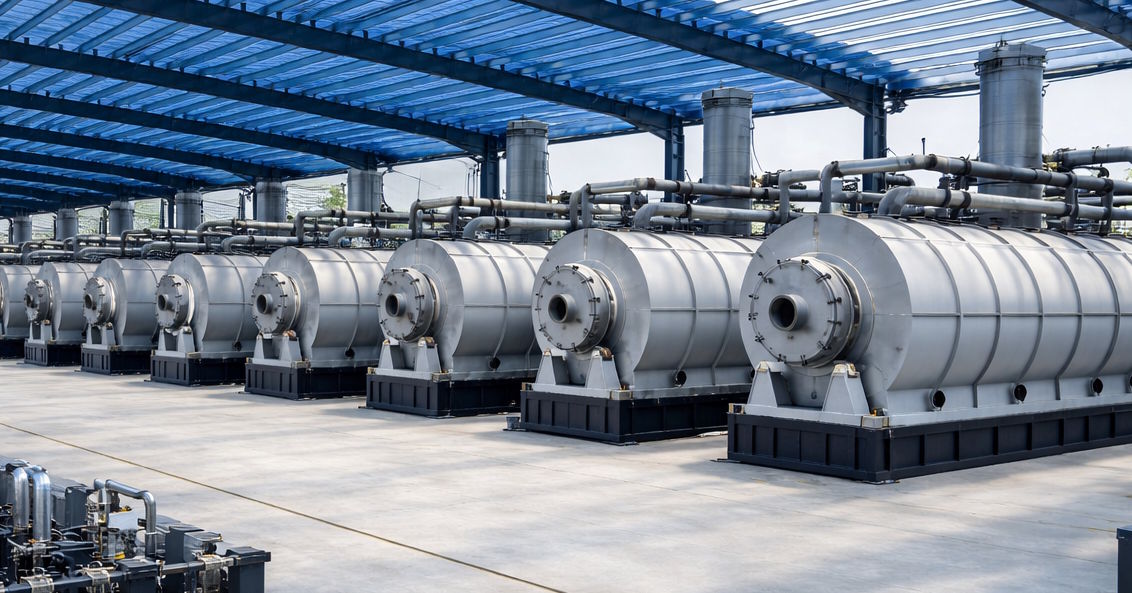
In most industrial infrastructure ventures, scale means size. Build a larger plant, deploy more capital upfront, and accept the risk that comes with commissioning unproven capacity. The investment is front-loaded, the timeline is long, and the consequences of underperformance are felt across the entire project.
PYROCY is built on a fundamentally different logic.
Replication, not enlargement
The PYROCY model achieves scale through the replication of standardised modular units — not through the construction of progressively larger facilities. Each unit is built to the same specification, assembled in the same factory, commissioned using the same procedures, and operated by teams trained to the same standard. When a site needs to grow, it adds a module. The technology does not change. The engineering does not need to be reworked. The operational playbook is identical.
This distinction has direct and significant implications for how capital is deployed and how risk is managed across a project.
The base unit
Each PYROCY pyrolysis unit is a skid-mounted, factory-assembled system engineered for rapid on-site installation. Units are fully automated and SCADA-controlled, requiring a minimal two-operator shift team for continuous industrial operation. From order to shipping takes approximately six months — with a further three to eight weeks for on-site installation and commissioning.
The modular footprint means that a site can begin production with a single unit and expand incrementally as performance is confirmed and revenues begin to flow. Each additional module reuses the existing site infrastructure, permitting framework, and operational team — making expansion significantly less capital-intensive than the initial deployment.
What this means for investors
A co-investor entering a PYROCY project is not betting on a large facility performing as modelled years from now. They are committing capital to a defined first module — with documented performance characteristics drawn from our operating facility in Portugal — and retaining a clear, low-friction path to expansion once local performance is validated.
Capital is deployed in phases. Each phase is justified by the performance of the previous one. And because every module is identical, the performance of one unit is directly predictive of the next. There are no engineering unknowns introduced by scaling up, no new technology risks, and no gap between what was modelled and what was built.
The compounding platform advantage
As PYROCY deploys more modules across more projects globally, the replication model becomes progressively more powerful. Operational data accumulates across multiple sites and feedstock types. Commissioning procedures are continuously refined. Equipment supply chains become more efficient. The time and cost required to deploy each new unit decreases as the platform matures.
This is the structural advantage of a global replication platform over a single-project developer — and it is one of the core reasons PYROCY is structured the way it is.
The plant in Portugal is module one. Everything that follows is built on the same foundation.